< Back to IRCAM Forum

Partiels v2.0.0 with Sonoma 14.2.1

I used Audioscult for several years, and I’ve been trying out Partiels on an M1 Mac using Sonoma 14.2.1.

I can load a sound which brings up a spectrogram and I can playback the sound. But if I double click on a plugin or press return, nothing happens. I did get an inharmonic Partial plugin to load (but I’m not sure why it worked that one occasion) but it displays nothing, and looking at the track results shows no values for each time segment.

I tried trashing the prefs and reinstalling, but it’s the same.

Any clues?
Thanks in advance!

Hello,

I assume that you are using the latest versions of Partiels and the Ircam Vamp plug-ins (2.0.0). If when you load an audio file, a waveform and spectrogram appear, this means that you are using a default template. Can you try without a default template as described in section 3.1 of the manual?
Menu → Partiels → Default Template → None, then select an audio file and add groups and tracks.

The new track issue might be related to the template. Let me know if it works and then we’ll figure out why you don’t have any results with the Inharmonic Partial Tracking plug-in (it might be related to the parameters, the audio content, etc.).

Best,
Pierre

Hi Pierre,

Thank you for your reply. That worked! So it appears that the default template doesn’t allow me to add new tracks but, as you described, using None works well.

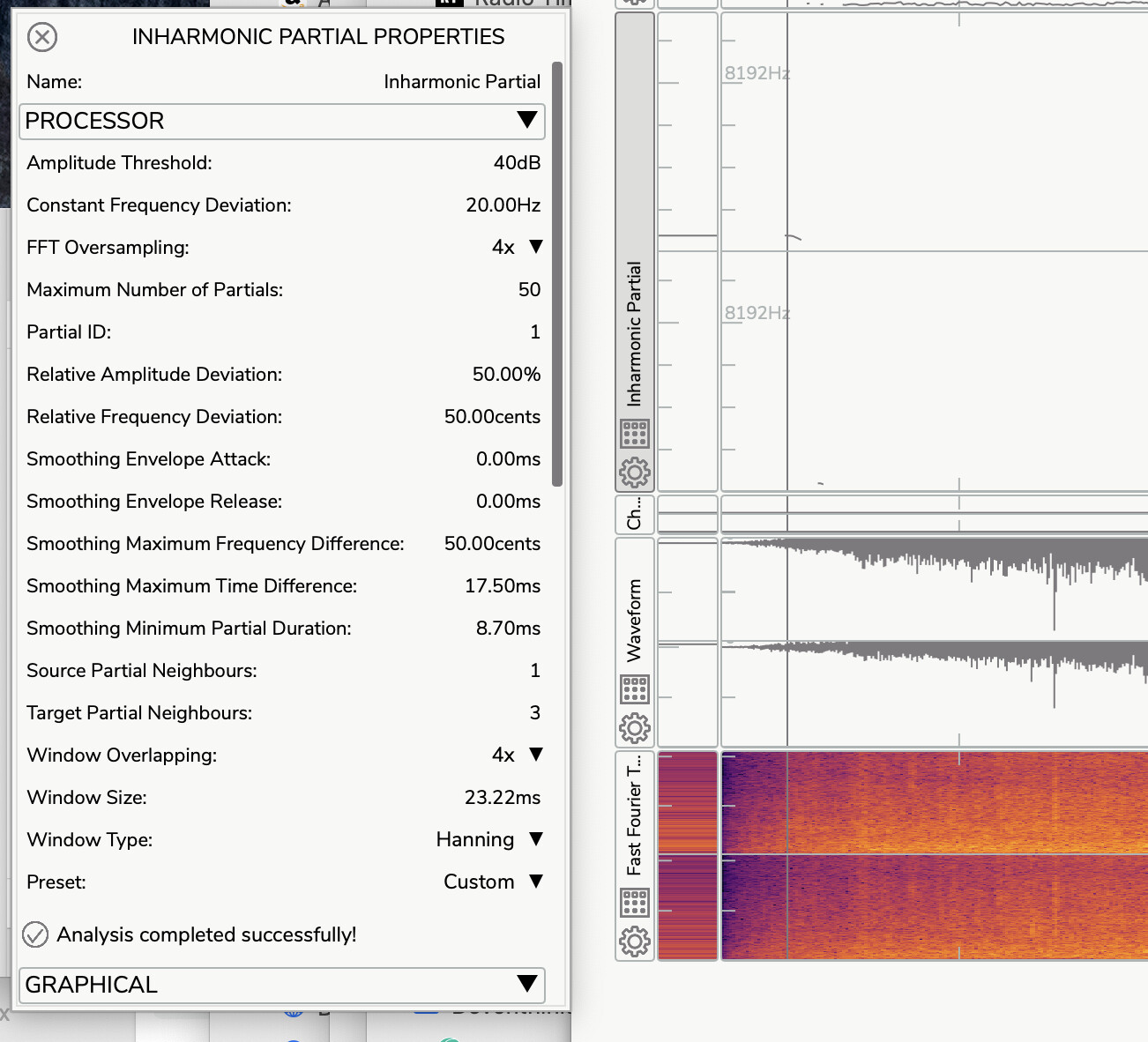
With Harmonic and inharmonic partial tracking, I am getting one partial for each analysis. How can I adjust the parameters to show more?

Thanks,
Andy

Thank you for your reply. That worked! So it appears that the default template doesn’t allow me to add new tracks but, as you described, using None works well.

Okay, I’ll try to figure out what’s the problem with the factory template. Thank you for your feedback.

With Harmonic and inharmonic partial tracking, I am getting one partial for each analysis. How can I adjust the parameters to show more?

Each partial corresponds to a track. So, if you want to analyze several partials, you have to create a new analysis track for each partial and specify the partial ID you want for the new track (1, 2, 3, etc.). If you don’t want to do it manually, you can use the template PM2-Partials-Tracking-Harmonic-20.ptldoc given with the Ircam Vamp Plug-ins manual that creates 20 partial tracks (or you can also do it once, save your document and use it as a template). If you need to modify the parameters of all the partial tracking tracks, you can do it via the properties of the group containing the tracks. Note that harmonic partial tracking requires an F0 analysis (this is already managed by the template of the Ircam Vamp Plug-ins manual).

Ah, that makes sense. I was thinking that it would work in the same way as Audiosculpt where each analysis gives many partials. I will spend some time and get familiar with the process. Thanks again for your help and for the Vamp manuals and templates.

1 Like

Dear Pierre,

I am working with Partiels v2.4.1 to analyse a trombone E1 sample.

I installed the Ircam Vamp Plugins and also tried the template PM2-Partials-Tracking-Harmonic-20.ptldoc. I can see the higher tracked components and I can also inspect a given frame with a frequency-bin / spectrogram reading.

However, my main difficulty is with the low partials, especially the fundamental region around E1 (~41.9 Hz). In practice, I am trying to find the correct workflow in Partiels if I want to do the following:

  • choose one stable frame of the sound,
  • identify the actual partials present in that frame,
  • and then reconstruct or derive approximate pitches from them for instrumental transcription or demonstration purposes.

What I would like to understand is not only how to read the spectrum, but also how one can go from that frame-based spectral reading to a simplified reconstruction: for example, an approximate chord, a set of pitches, or a basic instrumental resynthesis that could be shown in an analysis or teaching demonstration.

With PM2 harmonic tracking, the higher components appear much more clearly than the fundamental, and I am not sure whether the low partials are not being detected, or whether I should use a different processor, template, or view for this kind of frame-based reading and reconstruction.

So my question is:

What is the recommended way in Partiels to extract the low partials of a single frame of a harmonic instrumental sound, and then translate that reading into approximate pitches or a simplified spectral reconstruction?

Thank you very much for your help.

Best regards,
Manel Ribera

Hello Manel,

It’s difficult to determine how to improve the analysis without access to the audio file. However, since the fundamental frequency is low, the issue may come from inaccuracies in the fundamental frequency estimation. In that case, any partial analysis relying on it will also be affected.

You could try improving the fundamental analysis by adjusting the parameters (for example, by narrowing the minimum and maximum frequency range, and/or increasing the analysis window size in the parameters). Alternatively, you might try a different fundamental estimation method, such as Crepe. If needed, you can also manually edit the fundamental frequency curve.

Once the fundamental analysis is improved, the partial analysis will automatically update in real time, allowing you to directly observe the changes.

On another note, if you are looking for more “stable” analysis over longer segments (rather than frame-based results), you may want to explore partial chord analysis (a template is available). This approach provides stable partial frequencies between markers defined by another track (e.g., transient analysis, STT, or manual segmentation).

Best,
Pierre